GirlMath: Your Calm Is Your Edge
Women who invest tend to stay steady. Many more have yet to begin.
Jayashree DGuest Author
More women in India are investing, bringing skills they use every day. Anyone who tracks school fees, a team budget and the day the gas cylinder is due knows how to plan. Yet many leave their savings idle, though women in India outlive men by almost three years (government life tables, 2016-20), so their money must stretch further. In 20-plus years of banking, I rarely found women investors in India short of good sense. What many lacked was the habit of putting it to work.
A tale of two careful savers
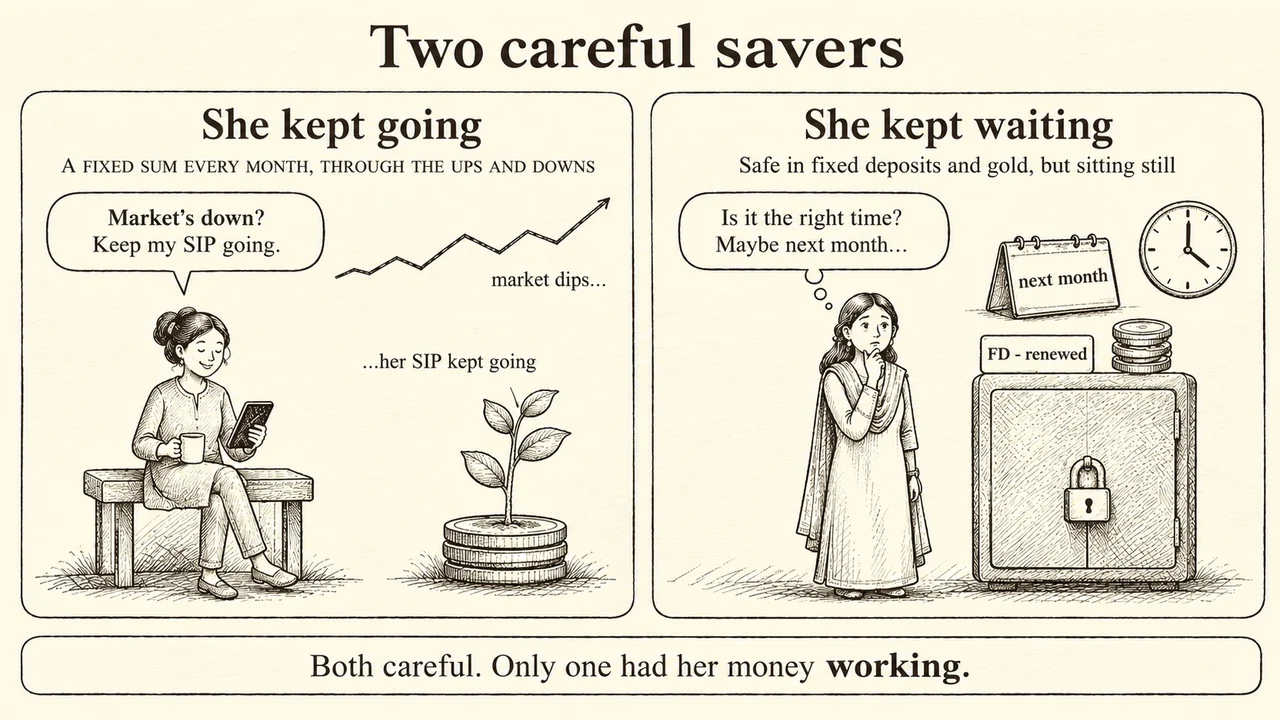
One client put a fixed sum into a mutual fund every month (opens in new tab). When markets fell, she called only to ask whether to keep going. Another saved every rupee in fixed deposits and gold, waiting for the right time. Like the perfect day to clear out the cupboard, it never came. Both were careful, but only one had her money working for her.
Calm pays
Among people trading shares within a single day in 2022-23, SEBI found fewer women than men lost money: about 66% against 72%. AMFI and Crisil's March 2024 figures show women tend to hold mutual funds longer, too.
So are women better investors than men? Not necessarily. Many simply react less to short-term moves, a habit anyone can build. It guards against overconfidence bias, a common trap in behavioural finance: the feeling that we know what the market will do next. In India it often arrives as a stock tip in the family group chat, somewhere between the good-morning flowers and a forwarded recipe. Every wrong guess has a cost, which explains much of why investors lose money (opens in new tab).
Where many women investors in India are missing out
By AMFI and Crisil's count, women were only one in four mutual fund investors in India at the end of 2024. Often, caution has quietly become the plan: savings rolled from one fixed deposit to the next. Fixed deposits and gold have a real job, but over 20 or 30 years, money that only sits safely can fall behind rising prices.
How to make your calm count
Match money to when you need it:
- Money you may need any day: a few months of expenses (opens in new tab) in a fixed deposit or savings account.
- Goals a few years away: debt or hybrid mutual funds, which swing less.
- Goals ten or more years away: a Systematic Investment Plan (SIP) (opens in new tab), a fixed monthly amount, in a diversified equity mutual fund.
Investing for women in India follows the same rules as for anyone.
Your calm is already an edge, and it pays only once your money is invested.
GirlMath comes from time.money, a fee-only investment advisor in India, registered with SEBI and paid only by its subscribers.
Next in GirlMath: When Safe Isn’t Enough
Sources
- Office of the Registrar General of India, Sample Registration System, Abridged Life Tables 2016-20 (opens in new tab). Life expectancy at birth: 71.4 years for women, 68.6 years for men.
- SEBI, Analysis of Intraday Trading by Individuals in Equity Cash Segment (opens in new tab), July 2024. Figures for financial year 2022-23.
- AMFI and Crisil, From Savings to Wealth Creation: Women Taking Charge of Investments (opens in new tab), March 2025. Holding periods as of March 2024; share of investors as of December 2024.
Written by
Guest Author20+ years' experience
Jayashree D spent more than 20 years in banking, from client desks to heading the Virtual RM vertical @Standard Chartered bank. She did it as a working mother, which taught her that the hardest part of managing money is finding the time to look at it. Through GirlMath, she shares what she wishes more women had heard sooner.
Reviewed by
Co-Founder & COO30+ years' experience
Over three decades across debt markets, mutual funds, and investment advisory. Former stints at Darashaw Securities, Kotak Mahindra Mutual Fund, and Entrust Family Office. At Karat Capital, he ensures that every feature, every communication, and every recommendation stays on the right side of SEBI regulations, so investors never have to wonder.