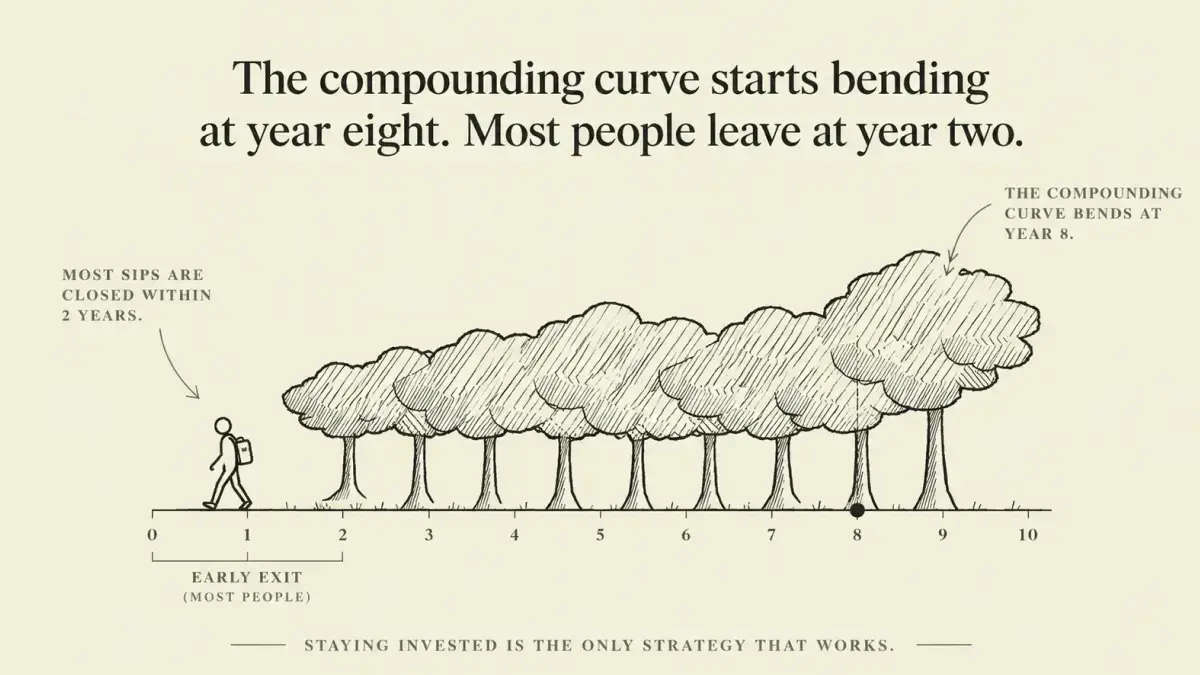
The compounding curve starts bending at year eight. Most people leave at year two.
Most SIPs in India are closed within 2 years, but the compounding curve only bends at year 8. Discover why staying invested is the only strategy that works.
Ramesh BukkaFounder & CEO
Compounding does not care how smart you are. Only how long you stayed.
The power of compounding (opens in new tab) in SIP (opens in new tab) is not a theory — it is a mathematical certainty. But it demands one thing most investors refuse to give it: time. Nearly half of all SIPs started in India are closed within two years. The compounding curve does not start bending until year eight. That six-year gap (between when most people leave and when the magic actually begins) is where most wealth is lost. Not to markets. Not to bad funds. Just to leaving too soon.
The wait — years 1 to 8
₹10,000 a month at 12%. Eight years in, you have around ₹15.7 lakh on ₹9.6 lakh invested. The gain is real. It just does not feel like the fortune everyone talks about. Slow is exactly when the noise gets loudest — gold is running, someone is making a killing somewhere else, something always sounds better. This is where FOMO and compounding meet — and where one of them has to lose. Research consistently shows that investor behaviour, not market performance, ends more SIPs than any bear market. (Source: AMFI/Business Standard, March 2025)
The turn — years 8 to 20
Around year eight, something shifts. The base is now large enough that the percentage returns start producing serious rupee numbers. Year ten — ₹22 lakh. Year fifteen — ₹48 lakh. Year twenty — ₹92 lakh. Act 2 has its own trap — not quitting, but tinkering. More compounding journeys end in Act 2 than Act 1. Not from panic. From enthusiasm.
What is the right time to start a SIP in India?
The right time is always now. Compounding returns in India are not driven by timing the market — they are driven by time in the market. A SIP started today at ₹10,000 a month has the same structural advantage as one started a decade ago. The only variable you control is when you begin.
What is investor behaviour and why does it matter?
Investor behaviour refers to the decisions investors make (often driven by emotion, fear, or FOMO) that interrupt the compounding process. In India, behavioural mistakes such as stopping SIPs during market corrections or switching funds frequently cause more wealth destruction than bad fund selection. Behavioural finance (a growing field in India) is the study of why investors consistently act against their own long-term interest.
Nifty 50, base 1,000 in 1995 to ~23,644 by 2024. Three acts, same 10-year window each. Act 1: +1,837 points. Act 2: +5,109 points. Act 3: +15,698 points. Same duration. The base got larger. The returns followed. Source: NSE / niftyindices.com
The leap — years 20 and beyond
Year twenty-five — ₹1.70 crore. Year thirty — ₹3.08 crore. The Nifty chart above says it better than any explanation. Same decade as Acts 1 and 2. Fifteen thousand points of gain versus less than two thousand. The base did what bases do when you leave them alone long enough.
The Act 3 investor did not do anything extraordinary. They just did not leave at year two.
The two moments that kill Act 3 are not a crash or a bad fund. They are the underwhelm of year two — and the overconfidence of year fifteen. Behaviour, both times. The investor who holds through both does not need luck. They need to recognise which act they are in — and do nothing (opens in new tab) clever. A fee-only investment advisor (opens in new tab) in India, with no product to sell and no commission at stake, is often the only person in the room who will tell you this plainly.
Compounding does not need you to be clever. It needs you to get out of its way.
Disclaimer: This article is for informational and educational purposes only and does not constitute investment advice. All calculations use ₹10,000/month at 12% p.a. and are illustrative — not a guarantee of future returns. SIP discontinuation data sourced from AMFI/Business Standard (March 2025). Nifty 50 historical data sourced from NSE/niftyindices.com. Past performance is not indicative of future results. Please consult a SEBI-registered investment advisor before making any investment decisions. time.money is registered with SEBI as an Investment Advisor (INA200015219).
Written by
Founder & CEO30+ years' experience
Two and a half decades of advising clients and investing proprietary capital across market cycles. Built his investment philosophy at HDFC Bank and Kotak Mahindra Bank, then co-founded Entrust Family Office where he worked closely with high net worth families on long term wealth planning. That experience revealed a gap: quality advisory was only accessible to the ultra-wealthy. Karat Capital Advisors was set up in 2020 to bring that same rigour and discipline to every serious investor.
Reviewed by
Co-Founder & COO30+ years' experience
Over three decades across debt markets, mutual funds, and investment advisory. Former stints at Darashaw Securities, Kotak Mahindra Mutual Fund, and Entrust Family Office. At Karat Capital, he ensures that every feature, every communication, and every recommendation stays on the right side of SEBI regulations, so investors never have to wonder.