Freedom has a year. Do you know yours?
Most urban professionals in India know their EMI. Almost nobody knows their debt-free year, the one number that decides whether retirement is free or trapped.
Ramesh BukkaFounder & CEO
Your debt-free year is the most important date on your financial calendar. Most people have never looked it up.
Most people know their EMI (opens in new tab) amount. Almost nobody knows their debt-free year. For most urban professionals in India, managing debt is often reduced to tracking the EMI. But the number that truly shapes financial outcomes is rarely discussed — it is the debt-free year: the year your last loan finally ends.
That number (the year your last loan ends) is one of the most important dates in your financial life. Not your retirement date. Not your children's college year. The year you stop paying someone else before you pay yourself.
For many urban professionals in India, that year sits uncomfortably close to retirement. For some, it sits past it. Which means the years you planned to live on your savings, you will still be servicing a loan. That is not a worst case scenario. For a large number of people, it is simply the plan nobody wrote down.
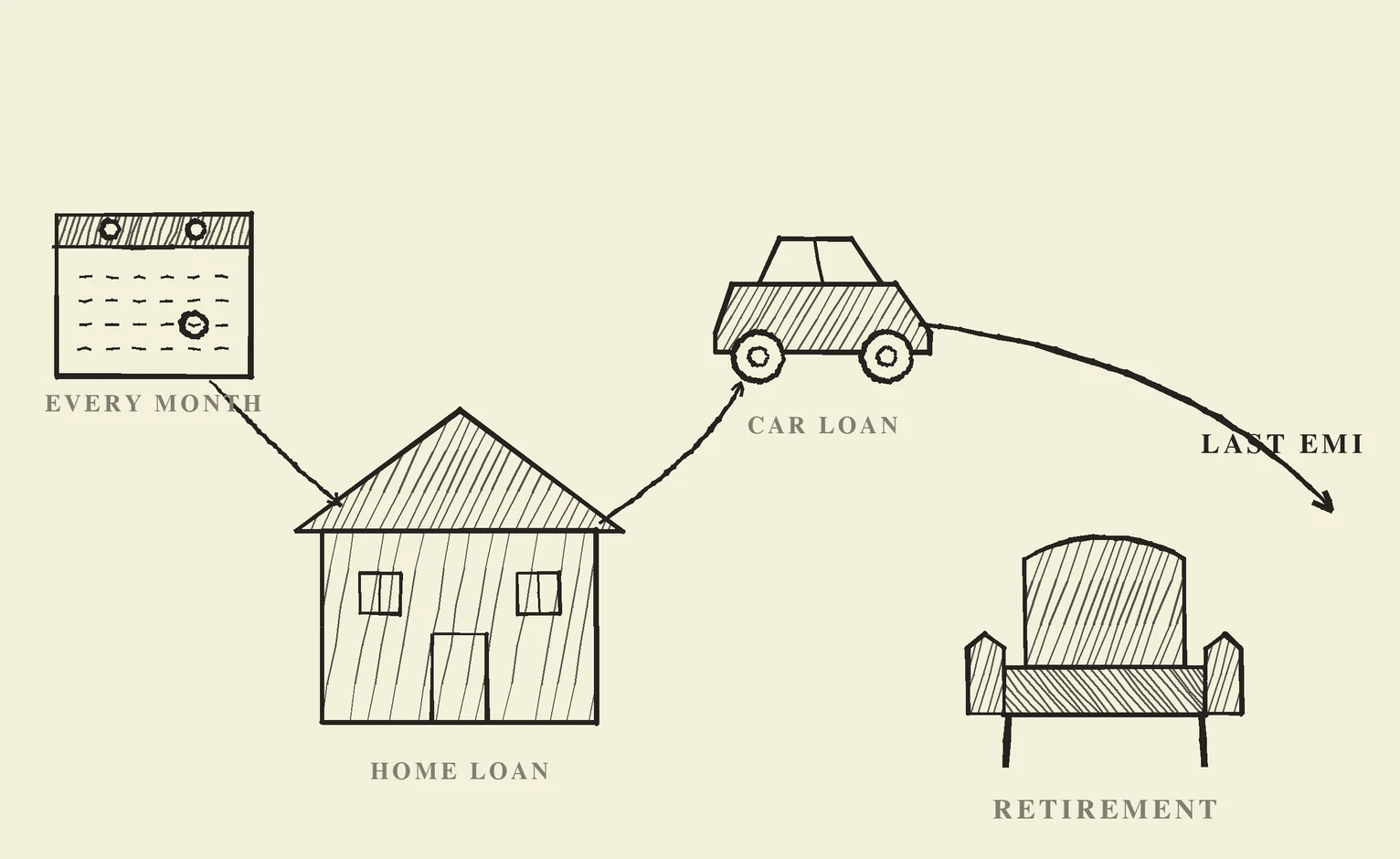
The timeline above uses example numbers. Yours will be different. But the question it asks is the same — when your income stops, will your EMIs have stopped too? If the answer is no, that gap is worth looking at now, not later. The further away your debt-free year sits from your retirement year, the harder the math becomes.
Loans are not the enemy. Loans that outlive your earning years are.
What is a debt-free year and why does it matter?
Your debt-free year is the calendar year in which your last EMI ends. For urban professionals in India, this is one of the most important numbers in retirement planning. If your debt-free year falls after your retirement year, your post-retirement income must still service EMIs designed for a working salary. Breaking the debt cycle before retirement is one of the most consequential and most overlooked decisions a salaried professional in India can make.
How does investor behaviour affect loan repayment decisions in India?
Behavioural finance India research shows that salaried professionals consistently underestimate how long their debt runs. The EMI feels manageable month to month — a form of present bias where the immediate cost feels small against a future problem that feels distant. A fee-only investment advisor (opens in new tab) in India, registered with SEBI, can provide the full picture: debt-free year, retirement year, and the gap between them — without any product to sell.
Three things to take away
1. Know the year, not just the EMI. The monthly amount feels manageable. The full picture (how many years it runs) is the number that actually matters for your retirement plan (opens in new tab).
2. Debt past retirement is not inevitable. A home loan (opens in new tab) that ends at 58 is very different from one that ends at 68. The decisions you make now (prepayments, loan tenure, new borrowing) all move that year.
3. The gap between your retirement year and your debt-free year is worth closing. Even small prepayments made consistently can pull that year significantly forward. The compounding (opens in new tab) works in reverse here too. Knowing your debt-free year, and actively managing it, is what separates a reactive borrower from a wealth-building investor. This is where conflict-free investment advisory makes the difference: a SEBI registered investment advisor works only for you, not for the lender.
Your debt-free year is one of the things time.money tracks in your Credit Wellness summary. If the number surprises you, that is exactly the point — and exactly where the work begins.
Disclaimer: This article is for informational and educational purposes only and does not constitute investment advice. The debt-free year calculations shown are illustrative and based on example figures — not a guarantee of individual outcomes. Please consult a SEBI-registered investment advisor before making any financial decisions. time.money is registered with SEBI as an Investment Advisor (INA200015219).
Written by
Founder & CEO30+ years' experience
Two and a half decades of advising clients and investing proprietary capital across market cycles. Built his investment philosophy at HDFC Bank and Kotak Mahindra Bank, then co-founded Entrust Family Office where he worked closely with high net worth families on long term wealth planning. That experience revealed a gap: quality advisory was only accessible to the ultra-wealthy. Karat Capital Advisors was set up in 2020 to bring that same rigour and discipline to every serious investor.
Reviewed by
Co-Founder & COO30+ years' experience
Over three decades across debt markets, mutual funds, and investment advisory. Former stints at Darashaw Securities, Kotak Mahindra Mutual Fund, and Entrust Family Office. At Karat Capital, he ensures that every feature, every communication, and every recommendation stays on the right side of SEBI regulations, so investors never have to wonder.