Why Your Best Friend Might Be Your Worst Financial Advisor
Is this my goal, or am I chasing someone else's success story?
Ramesh GovindanCo-Founder & COO
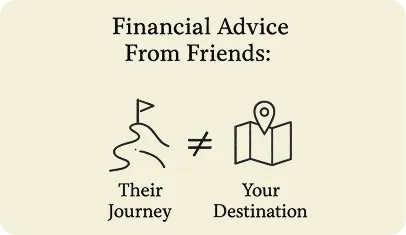
Let's start with an uncomfortable truth: financial advice from friends and relatives might be the most expensive free advice you'll ever receive. Your colleague made 20% on a mid-cap fund and swears by it. Your friend keeps forwarding WhatsApp messages about the "next big sector." Your uncle proudly shares his portfolio returns at every family gathering.
"With so much free advice flooding in, why pay for financial advice?"
Because when it comes to investing, particularly in mutual funds, trust in relationships often gets confused with suitability in investments, leading many down paths that weren't designed for their journey.
Everyone's Risk Appetite is a Fingerprint
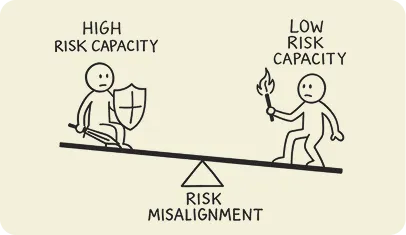
Risk tolerance (opens in new tab) isn't just a checkbox on a form — it's as unique as your fingerprint, shaped by your age, income stability, existing liabilities, future goals, and even your emotional makeup.
Let's consider an example. Rahul and Amit are 35. Rahul is a salaried IT professional with a home loan and two young children. Amit runs a successful business with substantial liquid assets. When Amit recommended his favorite small-cap fund that gave him good returns, Rahul jumped in — only to panic sell during a market correction.
What worked perfectly for Amit's risk profile became a source of anxiety and financial loss for Rahul.
Advice Without Context is Noise
"This hybrid fund gave me 15% returns!" — but over what period? Was it a lump sum investment during a market bottom or systematic investments through multiple cycles? What were the exit loads (opens in new tab)? What tax implications did they face?
Half-advice equals full risk. Investment recommendations shared without complete context are like following a GPS that shows only half the route. The road may look familiar at the start, but you could end up somewhere completely different than intended.
When someone shares their success story, they're often highlighting results without revealing the complete investment thesis or risk management strategy that guided their decisions.
Peer Pressure Investing is Real
Peer pressure isn't just a teenage phenomenon — financial FOMO is driving millions of Indian adults to chase trending funds and sectors, often at the expense of sound financial planning (opens in new tab).
A striking example: India saw 30 million new demat accounts opened every year since 2021, reaching 185 million by 2024, a surge largely attributed to social media hype and the urge to join the crowd rather than independent research or long-term goals.
This herd mentality has led to portfolios shaped more by what's popular in WhatsApp groups and office conversations than by individual financial needs, increasing risk and market volatility.
A Better Way: From Conversations to Consultations
Friendly advice doesn't have to be discarded entirely — it just needs reclassification. Instead of treating casual recommendations as action points, use them as conversation starters with qualified financial advisors (opens in new tab).
When someone shares their investment success, respond with curiosity rather than immediate action. Ask thoughtful questions about their overall strategy, risk management approach, and how this particular investment fits into their broader financial goals.
Before clicking "Invest Now," investors should pause and reflect whether they're pursuing their own financial objectives or merely attempting to replicate someone else's apparent investment success.
Your Portfolio, Your Personality
Your investment portfolio should be as unique as you are — reflecting your financial goals, risk tolerance, and life circumstances. It's perfectly fine if your asset allocation (opens in new tab) looks nothing like your brother-in-law's, even if his returns sound impressive at family gatherings.
The most successful investment strategy isn't the one with the highest return; it's the one you can stick with through market cycles while progressing toward your personal financial goals.
Written by
Co-Founder & COO30+ years' experience
Over three decades across debt markets, mutual funds, and investment advisory. Former stints at Darashaw Securities, Kotak Mahindra Mutual Fund, and Entrust Family Office. At Karat Capital, he ensures that every feature, every communication, and every recommendation stays on the right side of SEBI regulations, so investors never have to wonder.
Reviewed by
Founder & CEO30+ years' experience
Two and a half decades of advising clients and investing proprietary capital across market cycles. Built his investment philosophy at HDFC Bank and Kotak Mahindra Bank, then co-founded Entrust Family Office where he worked closely with high net worth families on long term wealth planning. That experience revealed a gap: quality advisory was only accessible to the ultra-wealthy. Karat Capital Advisors was set up in 2020 to bring that same rigour and discipline to every serious investor.