Why Doing Nothing Might Be the Smartest Investment Strategy You'll Ever Use
How emotional discipline transforms investing into true wealth.
Ramesh GovindanCo-Founder & COO
What if we told you that the smartest investors aren't the ones who keep tweaking their portfolios, but the ones who barely touch them at all?
While financial media celebrates active traders and market-timing gurus, quiet wealth is being built by those who set up their investments properly and then step away.
"Once your asset allocation (opens in new tab) is in place, the real skill lies in resisting the urge to constantly interfere."
Patience isn't just a virtue in investing — it might be your most powerful strategy.
Asset Allocation: Not Just About Diversification
Most articles oversimplify asset allocation as some magic ratio between stocks, bonds, and perhaps gold. But true asset allocation is far more nuanced — it's essentially a personalized risk behavior filter designed specifically for you.
It's not merely about spreading money across asset classes; it's about aligning your investments with your financial personality.
Your allocation should reflect your life stage, financial responsibilities, future goals, and perhaps most importantly, your anxiety threshold.
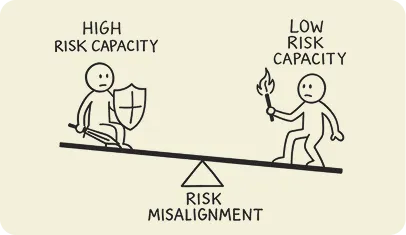
Someone who loses sleep over a 5% market drop requires a fundamentally different portfolio than someone who sees it as a buying opportunity.
Your asset allocation isn't just about maximizing mathematical returns — it's about creating a portfolio you can actually live with through market cycles without abandoning your strategy.
The "Do-Nothing Advantage"
Indian investors often fall into the trap of reacting to market swings, but recent data shows that patience pays off. Despite market fluctuations and corrections in 2024, India's stock markets showed strong overall performance over a two-year period, rewarding those who stayed invested rather than trying to time the market.
The steady growth in systematic investment plans (opens in new tab) (SIPs) demonstrates how consistent, disciplined investing can build wealth even through market volatility, as investors who maintained their regular contributions benefited from the long-term upward trajectory.
Yet, in early 2025, more SIP accounts were closed than opened for the first time since 2022, highlighting how investor caution and attempts to outsmart the market can backfire. Historically, frequent trading and market timing (opens in new tab) have led average investors to underperform their own funds by 3-4% annually, not because of poor fund choices, but due to ill-timed exits and entries.
The Indian experience reinforces this: wealth grows for those who stay the course, while each reaction to market noise erodes returns. In mutual funds, inactivity, not constant action, is often the path to real wealth creation.
Case Study: The Tale of Two Investors
Consider two investors who started with identical ₹10 lakh portfolios in 2013:
Investor A (Sanjay) carefully built a balanced allocation based on his financial goals and risk tolerance (opens in new tab). He automated his investments, revisited his allocation just once annually, and made only minor adjustments for rebalancing (opens in new tab). Market crashes made him nervous, but he reminded himself of his long-term plan and stayed the course.
Investor B (Rahul) started with a similar allocation but constantly adjusted his portfolio based on financial news, expert forecasts, and market sentiment. He moved to cash during market corrections, shifted heavily into equities during bull runs, and regularly switched funds chasing performance. Each move seemed logical at the time.
By 2023, Sanjay's portfolio had grown to ₹28 lakh, while Rahul's reached only ₹19 lakh. The difference wasn't from superior fund selection — it came from fewer behavioral mistakes, lower transaction costs, and the power of uninterrupted compounding.
Studies by Axis Mutual Fund and Morningstar India show that Indian investors consistently earn less than the funds they invest in, primarily due to frequent buying, selling, and reacting to market swings. Morningstar's "Mind the Gap" report found similar trends, with investors losing a significant portion of potential returns by trying to time the market or chase performance.
The evidence is clear: staying invested and avoiding constant churn is key to capturing full fund returns.
Mutual Fund Angle
For mutual fund investors, this approach becomes even more powerful. Systematic Investment Plans (SIPs) combined with a well-designed asset allocation create an investing autopilot that removes emotion from the equation. Market downturns become automatic buying opportunities rather than panic-inducing events.
The real value of SIPs isn't just rupee-cost averaging — it's behavioral management. By removing the decision of "when" to invest, you eliminate one of the major sources of investing mistakes.
But this advantage is completely negated if you pause or redirect your SIPs every time markets get volatile or financial headlines turn scary.
Self-Discipline: The Investment Strategy No One Can Sell You
The harsh reality that few financial advisors will admit: most portfolios don't fail because of bad funds or poor market performance — they fail because of restless investors who can't leave well enough alone.
Markets have historically rewarded patience, yet investors continue to damage their returns through hyperactive management.
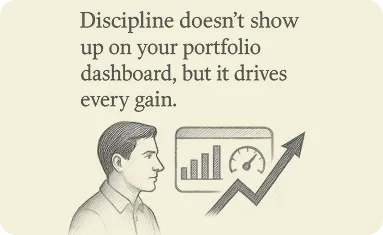
Once you've done the hard work of building your plan, your next move is... not to move. Your future self may thank you not for what you did with your investments, but for what you refrained from doing to them.
Written by
Co-Founder & COO30+ years' experience
Over three decades across debt markets, mutual funds, and investment advisory. Former stints at Darashaw Securities, Kotak Mahindra Mutual Fund, and Entrust Family Office. At Karat Capital, he ensures that every feature, every communication, and every recommendation stays on the right side of SEBI regulations, so investors never have to wonder.
Reviewed by
Founder & CEO30+ years' experience
Two and a half decades of advising clients and investing proprietary capital across market cycles. Built his investment philosophy at HDFC Bank and Kotak Mahindra Bank, then co-founded Entrust Family Office where he worked closely with high net worth families on long term wealth planning. That experience revealed a gap: quality advisory was only accessible to the ultra-wealthy. Karat Capital Advisors was set up in 2020 to bring that same rigour and discipline to every serious investor.