One loan. Two credit scores. One thing nobody tells you before you sign.
A joint home loan doubles your borrowing power, but ties your credit score to your co-borrower's repayments. Here is what most never discuss.
Ramesh GovindanCo-Founder & COO
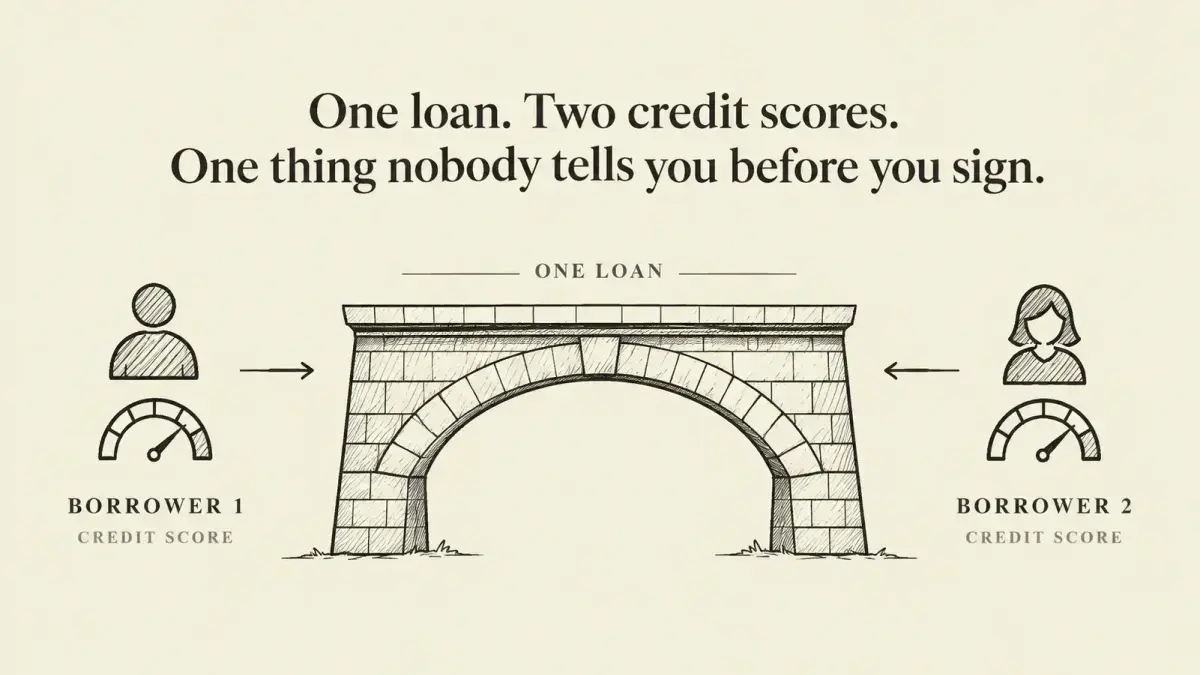
A joint home loan (opens in new tab) ties two financial lives together more deeply than most couples realise. Most treat it like paperwork.
The day you sign a joint home loan, something quiet happens that nobody at the bank mentions. Two names go on one document — and from that day, one repayment record gets shared between two people. Not eventually. From the very first EMI.
Most couples take a joint loan for the most practical of reasons. Combined income means a larger loan. Often a better rate. If one partner has a stronger credit score (opens in new tab), it lifts the overall application. The bank sees two incomes, two credit histories, and a lower risk. The numbers work. The paperwork gets signed. In India, a joint home loan is one of the most common financial decisions couples make — and one of the least discussed before the paperwork gets signed.
What rarely gets discussed is what that shared responsibility actually means on a bad month.
If your co-borrower misses a payment on the joint loan (even once, even by a few days), it shows up on your credit report too. Not their report. Both reports. You could pay your share without a single slip for twenty years and still watch your score move because of a decision you had no part in making.
This is not a flaw in the system. It is exactly how it is designed. Two names on a loan means two people equally accountable for what happens next.
Which is also why the income advantage works so well in the other direction. When both borrowers pay consistently and on time, both scores benefit. A partner who came into the loan with a weaker score can quietly rebuild it through two, five, ten years of clean repayment. The loan that looked like a compromise on day one can end up being one of the best things that happened to both credit profiles.
But the same connection that creates the upside also creates the exposure.
Does a joint home loan affect both credit scores in India?
Yes. In India, a joint home loan is reported on the credit records of all co-borrowers. Every EMI paid on time improves both scores. Every missed or delayed payment damages both — regardless of which borrower was responsible for that month's payment. Most couples never think about this until something moves unexpectedly.
What happens if one borrower misses an EMI on a joint home loan in India?
If one co-borrower misses an EMI, the missed payment is recorded on both borrowers' credit reports. The other co-borrower's credit score drops even if they were unaware of the missed payment. The full EMI obligation also falls on the remaining borrower. For a ₹60 lakh home loan, this can mean an immediate EMI burden of ₹45,000–₹55,000 per month on a single income — with no reduction in the loan balance.
If one income stops (job loss, illness, anything), the full EMI does not pause. It falls entirely on the other person. For a ₹60 lakh loan over 20 years, that is a weight most people have never planned to carry alone. A joint home loan protection plan addresses this specific risk — not every loan needs one, but a liability of this size over this tenure is worth covering. It is not about fear. It is about making sure the home stays in the family regardless of what life does.
Also worth knowing
Most people count the full loan liability against their net worth (opens in new tab). The honest number is half — your share of the outstanding balance, not the whole thing. Your net worth from a joint loan is likely better than you think.
Three things to take away
1. Your score is only as protected as the repayments on your shared loan. A missed payment by your co-borrower on the joint loan shows up on your report too. Understand this before you sign — not after something moves unexpectedly.
2. Close the score gap before you apply. Two strong scores get better terms than one strong and one weak. If there is a gap between your scores, it is worth closing before the application goes in.
3. Plan for one income before you need to. The question is not whether something could go wrong over twenty years. It is whether the loan survives if it does. For a joint home loan of this size and tenure, a protection plan is worth a conversation. A fee-only investment advisor (opens in new tab) in India (a SEBI registered investment advisor with no commission at stake) is often the first person to model this scenario honestly before the loan is signed.
A joint home loan is one of the most powerful financial tools a couple has. Two incomes, shared ownership, a larger asset built together. It works beautifully when both people understand what they have signed — and have planned for what they have not.
Disclaimer: This article is for informational and educational purposes only and does not constitute investment advice. All loan figures (₹60 lakh, 20-year tenure, EMI estimates) are illustrative examples only — not a guarantee of individual outcomes. Credit score impact will vary based on individual credit history and lender policies. Please consult a SEBI-registered investment advisor before making any financial decisions. time.money is registered with SEBI as an Investment Advisor (INA200015219).
Written by
Co-Founder & COO30+ years' experience
Over three decades across debt markets, mutual funds, and investment advisory. Former stints at Darashaw Securities, Kotak Mahindra Mutual Fund, and Entrust Family Office. At Karat Capital, he ensures that every feature, every communication, and every recommendation stays on the right side of SEBI regulations, so investors never have to wonder.
Reviewed by
Founder & CEO30+ years' experience
Two and a half decades of advising clients and investing proprietary capital across market cycles. Built his investment philosophy at HDFC Bank and Kotak Mahindra Bank, then co-founded Entrust Family Office where he worked closely with high net worth families on long term wealth planning. That experience revealed a gap: quality advisory was only accessible to the ultra-wealthy. Karat Capital Advisors was set up in 2020 to bring that same rigour and discipline to every serious investor.