You never missed an EMI. That is exactly why your SIP works.
Every EMI you paid on time was a SIP in disguise. The financial discipline that repaid your loan is exactly what builds long-term wealth, if you let it.
Ramesh BukkaFounder & CEO

One habit quietly trains you for the other. Most people never make the connection.
Nobody told you this was training. But it was.
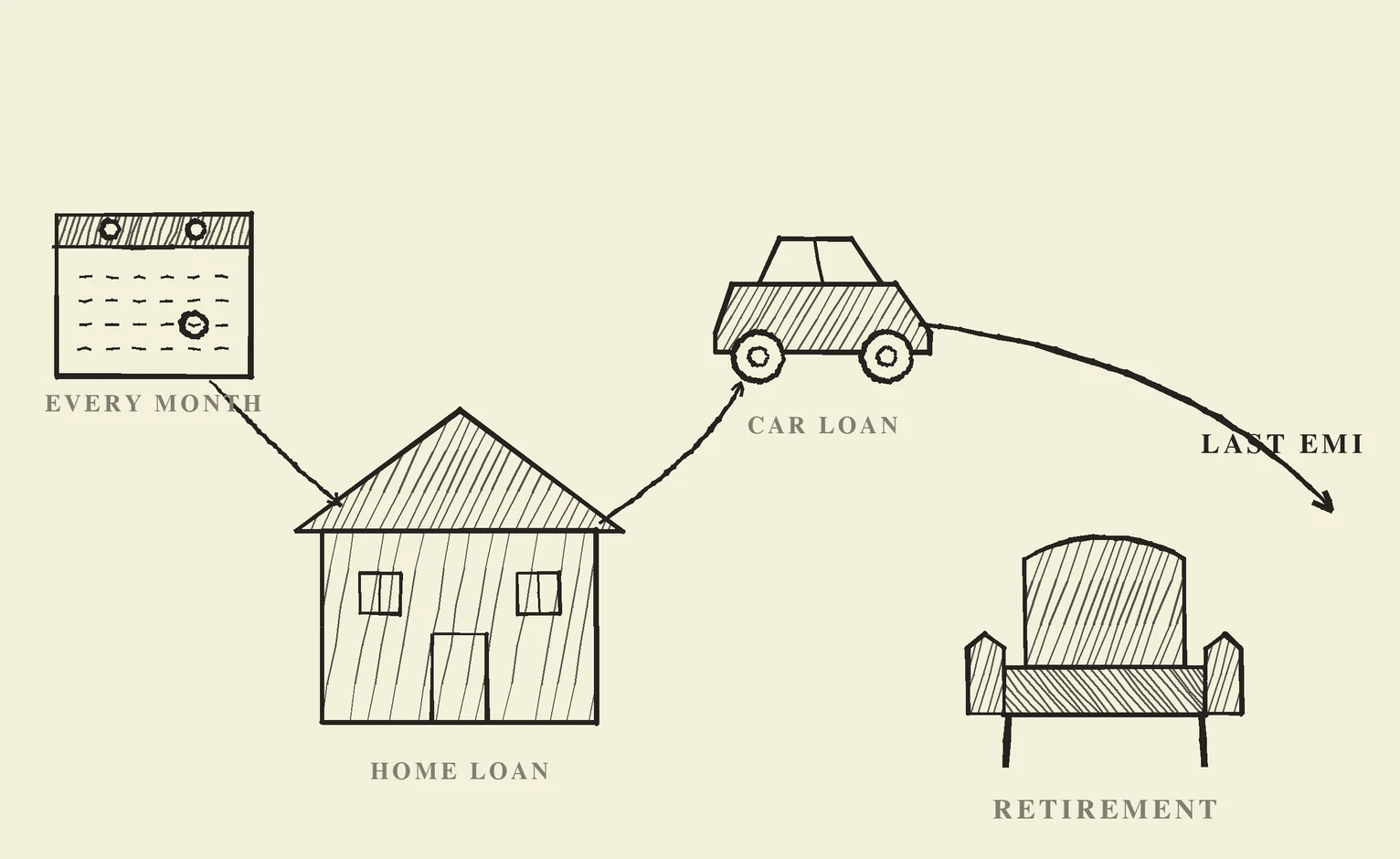
Every month the EMI (opens in new tab) went out (on the 5th, the 7th, whatever date yours is set to), something was being built quietly in the background. Not just a loan being repaid. A habit. The habit of letting money go to a commitment without asking yourself whether you felt like it that day. For urban professionals in India, the EMI is the most reliable financial habit they have built — often without realising it. That same discipline, redirected into a SIP (opens in new tab), is the foundation of long-term wealth.
That habit is rarer than it sounds. And it is exactly what investing asks of you.
The returns in investing do not go to the smartest people. They go to the ones who do not stop. The ones who keep the SIP running when the market is uncomfortable and everything is telling them to wait. The ones who treat their investment the way they treat their EMI — as something that goes out regardless of mood, regardless of the month.
Every EMI you paid on time was a SIP in disguise.
How is an EMI similar to a SIP in India?
Both an EMI and a SIP are fixed, recurring financial commitments made on a set date each month. The key difference is direction: an EMI repays borrowed money, while a SIP builds owned wealth. The financial discipline required is identical — which is why someone who has never missed an EMI is already demonstrating the exact behaviour that makes a successful long-term investor.
Why do investors stop SIPs during market corrections in India?
Behavioural finance research in India consistently shows that SIP discontinuation spikes during market corrections — the same periods when staying invested (opens in new tab) produces the most significant long-term gains. This is loss aversion: the psychological pain of watching a portfolio fall outweighs the rational understanding of compounding (opens in new tab). The investors who do not stop are typically the ones who have already built the habit of automatic, non-negotiable financial commitments — like an EMI.
The market will ask you to flinch at some point. What gets you through is not knowledge or research. It is the muscle memory of having done the right financial thing automatically, month after month, even when it was inconvenient. You build that muscle with an EMI. You use it with a SIP.
If the discipline has been inconsistent (if months have been missed, if the SIP has been paused), it is just a habit that has not been built yet. Start with one commitment. Honour it without exception. Then point it at your wealth. time.money tracks both sides of this (your Credit Wellness and your investment behaviour), so the discipline you have already built does not go to waste.
The one thing to remember
The discipline that paid your loan is the same discipline that builds your wealth. You do not need to find it. You just need to point it in the second direction.
The EMI mindset applied to wealth building is not complicated. It is just the same decision made twice — once because you had to, once because you chose to. That is the difference. And it is everything.
Disclaimer: This article is for informational and educational purposes only and does not constitute investment advice. The connection between EMI repayment behaviour and SIP investing discipline is illustrative and based on observed financial behaviour patterns — individual outcomes will vary. Please consult a SEBI-registered investment advisor before making any financial decisions. time.money is registered with SEBI as an Investment Advisor (INA200015219).
Written by
Founder & CEO30+ years' experience
Two and a half decades of advising clients and investing proprietary capital across market cycles. Built his investment philosophy at HDFC Bank and Kotak Mahindra Bank, then co-founded Entrust Family Office where he worked closely with high net worth families on long term wealth planning. That experience revealed a gap: quality advisory was only accessible to the ultra-wealthy. Karat Capital Advisors was set up in 2020 to bring that same rigour and discipline to every serious investor.
Reviewed by
Co-Founder & COO30+ years' experience
Over three decades across debt markets, mutual funds, and investment advisory. Former stints at Darashaw Securities, Kotak Mahindra Mutual Fund, and Entrust Family Office. At Karat Capital, he ensures that every feature, every communication, and every recommendation stays on the right side of SEBI regulations, so investors never have to wonder.