The Basics of Investing in Index Funds: Boring Is Brilliant in the Long Run
Boring is brilliant in the long run. A plain-language guide to what index funds are and why they're a smart place for new investors to start.
Ramesh BukkaFounder & CEO

You don't need to pick winners. You need to own the market.
You don't have to know which stock will win next year. No one knows. In case you are just beginning your investing journey and not sure where to begin, investing in index funds will be a great start.
Most people assume investing means finding the right company or the right fund at the right time. It's the hardest way to start, and for a first-time investor, index funds are much easier.
Index Funds: What You're Actually Buying
An index fund is a basket of stocks that mirrors a market index: a bit of this company, a bit of that one, dozens of businesses in a single investment. Buy it, and your money gets spread across all of them, in roughly the same proportion as the market itself.
This is different from a regular actively managed (opens in new tab) mutual fund, where a professional fund manager keeps picking and adjusting stocks for you, and therefore charges a higher fee for the effort.
What an index fund holds, and why spreading risk across many companies beats betting on one.
Why Boring Works
Picking a single stock that consistently beats the market is harder than it looks, and even professionals struggle with it. Over the 10 years ended December 2025, 76.3% of actively managed Indian large-cap funds underperformed their own benchmark index (opens in new tab) (SPIVA India Scorecard, S&P Dow Jones Indices).
Many trained fund managers do this full-time and still mostly fall short. A single stock, or a handful of self-picked ones, carries real risk for someone just starting out. One bad quarter, one bad call, and the damage shows up fast. An index fund spreads that risk across dozens of companies instead.
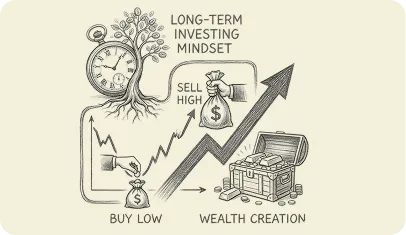
This approach has a name: passive investing, since nobody involved is trying to outsmart the market, just own a piece of it.
Why People Still Try to Pick Winners
Part of the pull is overconfidence bias: the tendency to believe you're a better judge of a good stock than you actually are. It's rarely arrogance; a few lucky calls just tend to feel like skill.
Part of it is illusion of control: the sense that your own choices shape an outcome more than they really do, especially somewhere as unpredictable as the market. Picking a stock feels like doing something. An index fund can feel like doing nothing, even when it's working exactly as intended.
Where to Start
Opening a SIP (opens in new tab) in an index fund is about as simple as investing gets. No tracking quarterly results, no comparing valuation ratios, just a fund that tracks a broad index, and a monthly amount you're comfortable with.
Most Mutual Fund houses let you start with ₹500 or ₹1,000 a month. No stock-picking skill required, just consistency and most importantly a clear 10 year plus investing outlook.
This is how most people actually build wealth: slowly, and without having to be right about anything.
time.money is a unit of Karat Capital Advisors Pvt Ltd, a fee-only (opens in new tab), SEBI-registered advisory platform, because knowing where to start shouldn't require knowing everything first.
Disclaimer: The sector composition and performance illustrations in this article are for educational purposes only and do not represent any actual fund, index, or security. Fund underperformance data is sourced from the SPIVA India Scorecard, Year-End 2025 (S&P Dow Jones Indices LLC), measuring Indian Equity Large-Cap funds against the S&P India LargeMidCap benchmark over the 10 years ended December 31, 2025. Past performance is not indicative of future results. Mutual fund investments are subject to market risk. Please read all scheme-related documents carefully. This article is for informational purposes only and does not constitute investment advice. time.money is a unit of Karat Capital Advisors Pvt Ltd, a SEBI-registered investment advisor (INA200015219); please consult your advisor before making investment decisions.
Written by
Founder & CEO30+ years' experience
Two and a half decades of advising clients and investing proprietary capital across market cycles. Built his investment philosophy at HDFC Bank and Kotak Mahindra Bank, then co-founded Entrust Family Office where he worked closely with high net worth families on long term wealth planning. That experience revealed a gap: quality advisory was only accessible to the ultra-wealthy. Karat Capital Advisors was set up in 2020 to bring that same rigour and discipline to every serious investor.
Reviewed by
Co-Founder & COO30+ years' experience
Over three decades across debt markets, mutual funds, and investment advisory. Former stints at Darashaw Securities, Kotak Mahindra Mutual Fund, and Entrust Family Office. At Karat Capital, he ensures that every feature, every communication, and every recommendation stays on the right side of SEBI regulations, so investors never have to wonder.