Retirement Planning in India: How Much You Need and How to Start
A plain guide for salaried professionals: what to count, what inflation does to your savings, and the steps that matter most.
Written by
Ramesh BukkaCEO & Founder, time.money
Reviewed by
Ramesh GCOO & Co-founder
Published
10 Min Read
Summary
Retirement planning is working out how much money you will need after your regular income stops, and building it through regular investing while you still do. For salaried professionals in India, that means estimating your future monthly costs after inflation, counting what EPF, NPS and your other savings will provide, and closing the gap steadily. The earlier you start, the smaller each monthly amount needs to be.
A note from our founder
The biggest thing people get wrong is starting late. Most only start thinking about retirement in their late 30s. They also underestimate how long they will live, what healthcare will cost and what inflation does over the years.
What is retirement planning?
Retirement planning is deciding when you want to stop working, estimating what life will cost from then on, and building enough savings to pay for it. It comes down to a number and a plan: how much you will need, and how much to invest each month to get there.
Many people see it as something for later. The choices that matter most are made in your 30s and 40s, because that is when time can do the most work for you.
A note from our founder
Here is an example I have seen in many forms, across middle-aged and older clients. It is a composite, not a real client. A 48-year-old salaried professional spends ₹1 lakh a month and plans to retire at 60. He has EPF and some fixed deposits and feels they will manage. He is planning for his own life to last until about 80, and he has counted today's costs. At 6% inflation, the same lifestyle costs about ₹2 lakh a month by 60, and his parents' healthcare or a longer life stretches the number further. The gap shows up only when someone writes the numbers down.
How much do I need to retire in India?
It depends on how you want to live, how long the money has to last and what your savings can earn. You can work out your own number in four steps.
- Start with today's monthly spending. Include rent or EMIs, food, bills, travel and health costs. Note which will fall after you retire, such as commuting and loan repayments, and which will rise faster than other costs, such as medical care.
- Grow it to your retirement year. Costs rise with inflation, so a lifestyle that costs ₹50,000 a month today will cost far more when you retire. The next section shows how much.
- Decide how long the money must last. Pick an age to plan to, and lean towards the longer side if your family tends to live long. Planning for a long life is the safer choice, and you can always revise it.
- Work out the savings that can fund those years. The retirement corpus has to pay for your costs after inflation, while the part you have not spent keeps earning. Count EPF, PPF, NPS, mutual funds (opens in new tab) and other assets, and set against them any loans, children's education and other large costs before retirement. A good estimator does this arithmetic for you.
Treat the result as a range and check it every few years, as your income, costs and plans change. That also answers a question many people ask, which is how long their retirement savings will last. The answer depends on how much you spend each year and what the rest earns.
Retirement does not have to mean income drops to zero. Many people do some consulting or other work in the early years of retirement. Even a modest income delays the first withdrawal from the corpus, so the same savings last longer and the runway gets longer.
If you want to leave something to your heirs, remember that in India the legacy is usually property, either your primary home or other property. Decide whether that already covers what you want to leave, so the corpus can be planned around your own years.
A note from our founder
People think in straight lines, so it is hard to feel what a few percent a year does over decades. Healthcare is the sharpest case. Estimates put medical costs in India rising by about 12 to 14% a year (see Sources), far faster than everyday prices. At 12% a year a cost doubles roughly every six years.
How does inflation affect retirement savings?
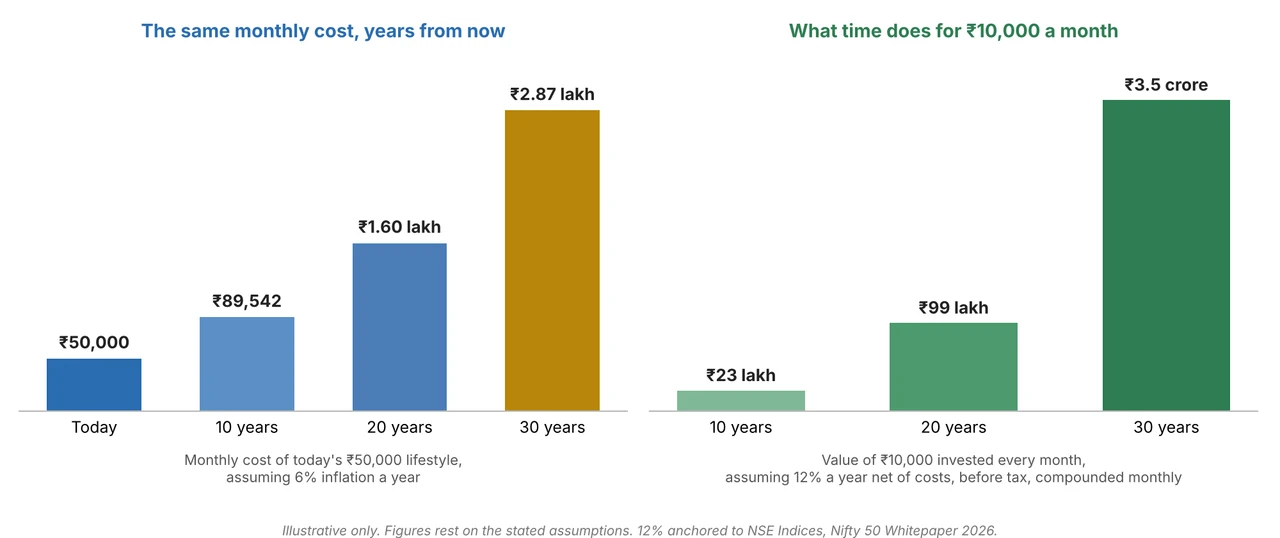
Inflation makes the same lifestyle cost more every year, so your savings have to grow just to keep pace. At an assumed 6% a year, a monthly cost of ₹50,000 today becomes about ₹89,500 in 10 years, ₹1.60 lakh in 20 years and ₹2.87 lakh in 30 years. The 6% is an illustrative assumption.
In retirement this works against you every year, because your salary stops rising while your costs keep climbing. A plan built on today's expenses usually falls short.
When should I start saving for retirement?
As early as you can, because time does much of the work. ₹10,000 invested every month at an assumed 12% a year, after fund costs and before tax, grows to about ₹23 lakh in 10 years, ₹99 lakh in 20 years and ₹3.5 crore in 30 years, as the right-hand chart shows. The 12% is anchored to Nifty 50 total returns of 12.44% a year over 20 years and 12.74% a year since its start in 1995, both to February 2026 (NSE Indices Limited, Nifty 50 Whitepaper 2026). Past returns do not guarantee future ones.
Whether you are starting retirement planning in your 30s or catching up in your 40s, the same arithmetic applies: every year you wait raises the monthly amount you need. Starting late is still worth it, and the usual fix is to invest more each month and raise the amount as your income grows.
A note from our founder
Most salaried clients I meet do not count EPF as part of their saving engine, because the money is not easily available to them. They treat it as a cushion for any shortfall in retirement.
Is EPF enough for retirement?
For most salaried professionals, EPF is a strong base and rarely the whole answer. It is built from a share of your salary that you and your employer contribute, so what it grows into depends on your pay and how many years you stay employed. Compare your expected EPF balance with your retirement number. Whatever gap remains is what your other investments have to cover, which is why retirement planning for salaried professionals usually combines EPF with other savings. A sound investment plan for a salaried professional starts by knowing that gap.
A note from our founder
In the families I have worked with, saving for their own retirement came last. Depending on the need, children's education and parents' health took precedence.
What is the three-way squeeze in retirement planning?
The three-way squeeze is the pressure many investors face when building a retirement corpus: a child's higher education, healthcare for ageing parents and your own retirement all need money at the same time. They tend to arrive in your 40s and 50s, and each one draws on the same savings. Money spent on one stops growing for the others, and retirement is the one that has no loan to fall back on.
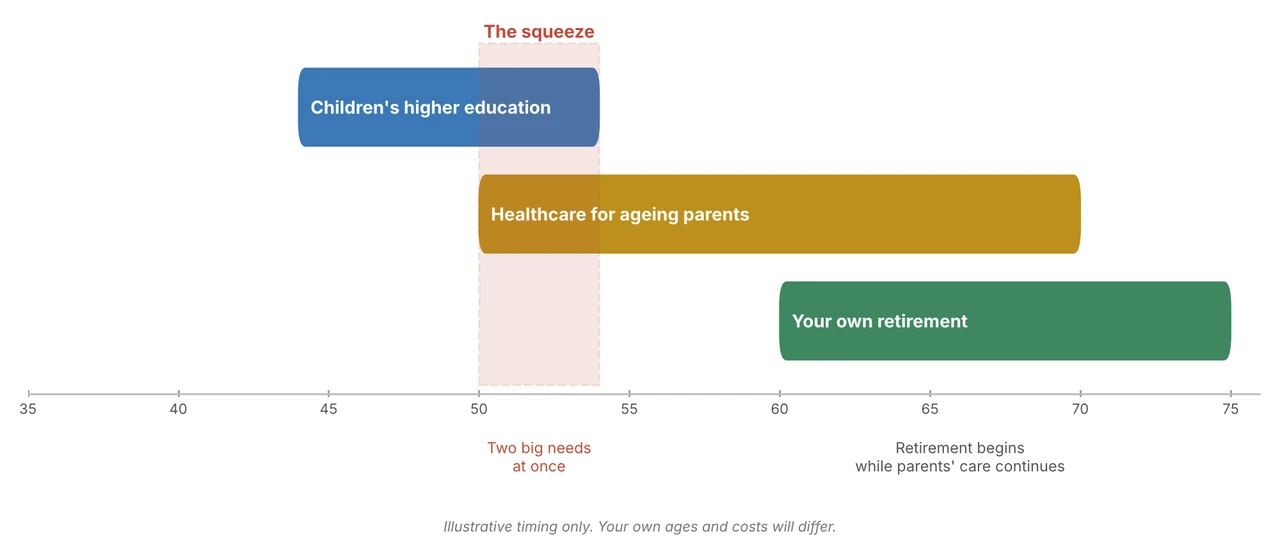
Put a rough cost and a year against each need to see how much room is left for retirement saving. The estimator below takes your children's education costs and other commitments into account, which a simple rule of thumb cannot do.
How can I check if I am ready to retire?
A good retirement number is personal, and a rule of thumb cannot give you one. The Retirement Readiness Estimator (opens in new tab) on time.money works it out from your own life. You answer a guided set of questions about your age, your savings, your loans, your goals, what you would like to leave behind and the kind of retirement you want, from Essentials to Comfortable to Aspirational. It then shows whether you are on track and how long your savings could last through retirement.
The estimator speaks to where you are in life, whether you are early in your career or close to retiring, and you can see how your result changes if you retire a little later or raise your monthly investment. We keep the figures inside the tool, where they update with your details, so the best way to see yours is to try it. Results also vary with your risk profile, because the mix of equity and debt in your investments changes what they can earn.
Check your own retirement readiness
Log in to your time.money account (opens in new tab) and open the Retirement Readiness Estimator. Details you have already added, such as your EPF, PPF and NPS balances, are filled in for you and you can edit them. Add your loans, the age you want to retire, the kind of retirement you want and anything you would like to leave behind. You then see whether you are on track, how long your savings could last, and how the answer changes if you retire later or invest more each month.
Where can I invest for retirement in India?
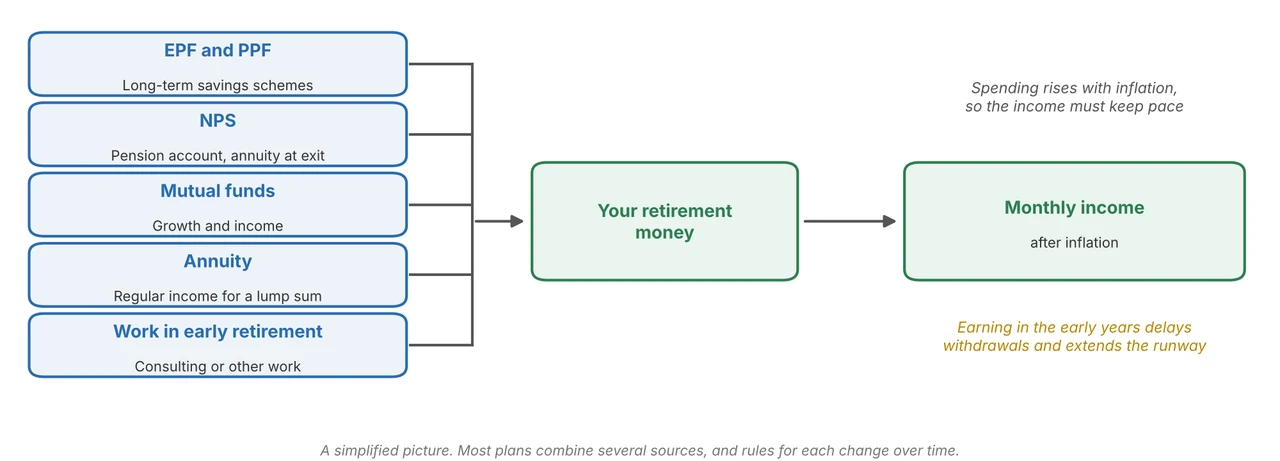
Most retirement plans combine a few types of investment, because each does a different job:
- EPF and PPF. Long-term savings schemes linked to the government. Their rates are set from time to time, so check the current rate before relying on one.
- NPS. A defined contribution pension scheme regulated by PFRDA. Part of the corpus must be used to buy an annuity when you exit, and the exit rules can change, so check PFRDA's current rules.
- Equity mutual funds, including index funds. These aim at growth over long periods. Their value can fall, sometimes sharply, so they suit money you will not need for many years. Many people reduce the equity share gradually in the few years before retiring.
- Annuities. These pay a regular income in return for a lump sum and are usually considered closer to retirement.
How much goes into each depends on your age, your goals and how much risk you can handle. A portfolio that suits a 35-year-old will look different from one for a 58-year-old.
A note from our founder
The mistakes I see are mostly behavioural. After Covid, some seasoned investors sold while the market was falling and came back only after much of the recovery had happened. Nifty 50 touched a low of 7,511 on 23 March 2020 and was back above 12,000 by 6 November 2020. In the cases I saw, those who sold and re-entered lost far more than if they had stayed invested.
What mistakes do people make in retirement planning?
Most of them start with how we think about money:
- Underestimating the future. Optimism bias is believing things will work out better than the numbers suggest. It leads people to overestimate return expectations and plan lower costs than they may face.
- Starting late. Present bias, the pull of today's wants over tomorrow's needs. Each year of delay raises the monthly amount you need.
- Selling after a fall. Loss aversion makes a loss feel more painful than an equal gain feels good, and can push people to sell at the wrong time.
- Playing it too safe. Keeping nearly everything in cash and fixed deposits can leave savings short once inflation is counted.
Should I use a SEBI registered investment advisor for retirement planning?
An adviser helps most when your goals compete for the same money or when you are unsure which number to aim for. If you choose one, check that they are registered, ask how they are paid, and read our guide to SEBI registered investment advisors (opens in new tab). time.money is a subscription-based SEBI registered investment advisor (INA200015219), run by Karat Capital Advisors Pvt Ltd. We are fee-only: you pay a subscription and we earn nothing from the products you choose.
Sources
- PFRDA, Frequently Asked Questions, All Citizen Model (NPS). Used for NPS, its regulator and the annuity requirement at exit. The FAQ is undated, so check PFRDA for current rules.
- NSE Indices Limited, Nifty 50 Whitepaper 2026, Chapter 1 and Exhibit 12. Nifty 50 total returns of 12.44% a year over 20 years and 12.74% a year since 3 November 1995, to 27 February 2026.
- Milliman, Measuring medical inflation in India (8 April 2026), citing market reports of 12% medical inflation in 2024 and a projected 13% in 2025; DSIJ, Medical Inflation Is Running at 12-14% Annually. These are estimates and vary by source.
- Business Standard, Nifty makes K-shaped recovery to wipe out Covid losses, crosses 12K-mark (6 November 2020). Nifty 50 low of 7,511 on 23 March 2020 and back above 12,000 by 6 November 2020.
- Calculations by time.money: ₹50,000 × 1.06 for 10, 20 and 30 years; ₹10,000 a month at 12% a year, compounded monthly, for 120, 240 and 360 months.