Mutual Funds in India: What They Are and How to Invest
A plain guide for beginners to how mutual funds work, the main types, what they cost, how to choose one and how to start with a SIP.
Written by
Ramesh GCOO & Co-founder, time.money
Reviewed by
Ramesh BukkaCEO & Founder
Published
16 Min Read
Summary
A mutual fund pools money from many investors and invests it in shares, bonds or other securities through a professional manager. You hold units, and the price of a unit, called the NAV, moves with the value of what the fund owns. In India you can start with a one-time KYC, choose a fund that fits your goal and the risk you can handle, and invest through a monthly SIP or even a lumpsum.
What is a mutual fund?
A mutual fund is a way of pooling money. Many investors put money into one fund, the fund buys a spread of shares, bonds or other securities with it, and everyone shares the gains or losses in proportion to what they put in. SEBI's investor education programme describes it as a mechanism for pooling resources by issuing units to investors, and the people who hold those units are called unitholders. A fund must be registered with SEBI before it can collect money from the public.
Pooling does three things that are hard to do alone with a small amount. It spreads your money across many securities, it puts a professional manager in charge of the portfolio, and it lets you start with a modest sum. The spread matters because, as SEBI's material puts it, diversification reduces risk since all stocks may not move in the same direction.
A note from our co-founder
The misunderstandings I meet most are that a mutual fund is a single asset class, that it is a guaranteed product, or that it is only a short-term investing tool. Used well, a fund can match your risk appetite, your goals and your time horizon.
How does a mutual fund work?
A mutual fund is set up as a trust. A sponsor creates it, trustees hold its property for the unitholders and oversee the manager, an asset management company (AMC) approved by SEBI makes the investment decisions, and a custodian registered with SEBI keeps the securities safe. (SEBI Investor Education Programme, Investment in Mutual Funds)
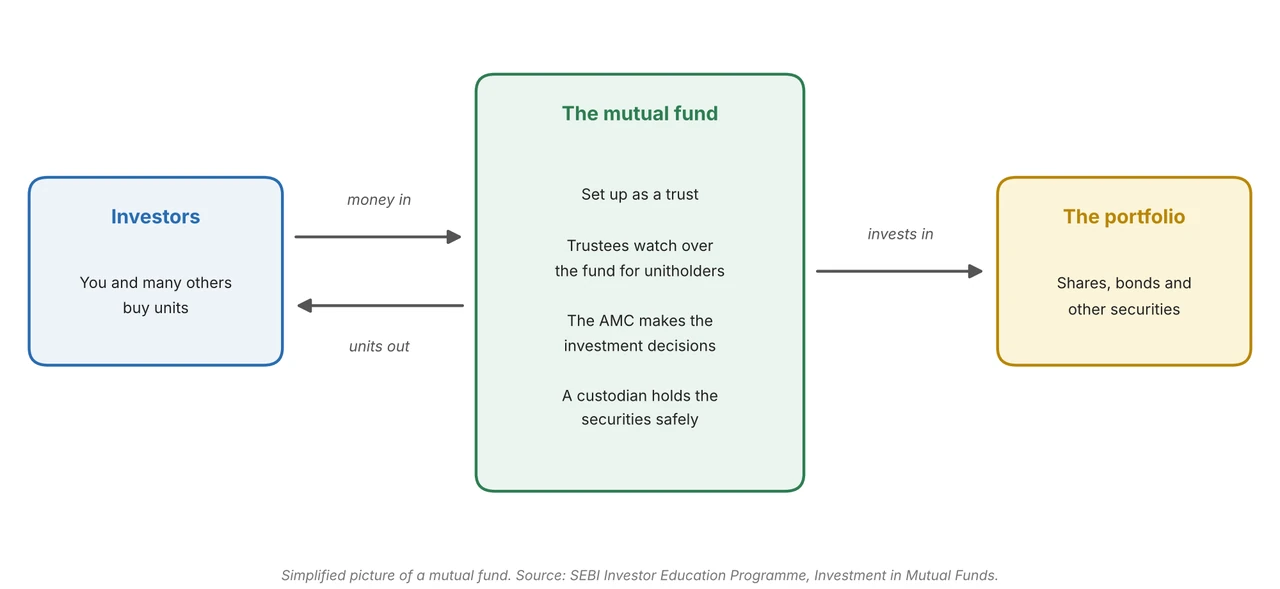
When you invest, you receive units. The price of one unit is the net asset value, or NAV: the market value of the securities the scheme holds divided by the number of units. SEBI's example is securities worth ₹200 lakh across 10 lakh units, which gives a NAV of ₹20 a unit. Funds must publish their NAV regularly, daily or weekly depending on the type of scheme, and AMFI's (Association of Mutual Funds in India) website gathers the NAVs of all funds in one place. A fund's NAV says nothing by itself about whether the fund is cheap, dear or good. What matters is how its value changes after you buy.
What are the main types of mutual funds?
Funds are grouped in a few ways, and the groups overlap.
- By how you buy and sell. An open-ended fund accepts new money and takes units back on a continuous basis. A close-ended fund has a fixed life and closes to new money after its launch offer (SEBI).
- By what the fund aims to do. Equity funds aim for growth over the long term, debt funds aim for regular income, and hybrid funds combine the two (SEBI investor education slides).
- By style. A passive fund such as an index fund copies a market index. An active fund has a manager who tries to do better than the market, and it usually costs more (SEBI investor education slides). We explain index funds in a separate guide.
- By special purpose. Money market and liquid funds hold short-term instruments, gilt funds hold government securities, sector funds hold one industry, and funds of funds hold other funds.
| Type | Aims at | Usual risk | Often used for |
|---|---|---|---|
| Equity | Growth over the long term | Higher. Value is volatile | Goals many years away |
| Debt | Regular, steadier income | Lower. Value is steadier | Money needed sooner, or to steady a portfolio |
| Hybrid | A mix of growth and income | In between, depending on the mix | One fund that holds both |
SEBI sets the official fund categories and revises them from time to time. In a circular dated 26 February 2026, it discontinued solution-oriented schemes and introduced life cycle funds. Because the list changes, check the current categories on SEBI's or AMFI's website before you compare funds. The next section lists them.
What are the SEBI mutual fund categories?
SEBI groups schemes into equity, debt, hybrid, life cycle and other schemes, and each group has named categories with its own rules. The tables describe them in plain words. They show how a category is built and are no recommendation to buy one. Your choice depends on your goal, your time horizon and the risk you can handle.
Equity funds
| Category | What it holds | What to know |
|---|---|---|
| Large cap | Mainly the largest listed companies | Usually steadier than smaller companies, though still subject to market risk |
| Mid cap | Mainly mid-sized companies | Can grow faster and fall harder than large caps |
| Small cap | Mainly smaller companies | The widest swings in this group, so it is often held for long periods |
| Large & mid cap | A mix of large and mid-sized companies | Two size bands in one fund, with a minimum in each |
| Multi cap | Large, mid and small companies together | SEBI sets a minimum share for each size band |
| Flexi cap | Companies of any size | The manager decides the mix, so you rely on their judgement |
| Focused | A small, concentrated set of stocks | Each stock matters more, so the fund can swing more |
| Value | Stocks the manager sees as priced below their worth | Value investing can lag for long stretches |
| Contra | Stocks that are currently out of favour | A contrarian approach that needs patience |
| Dividend yield | Companies that pay regular dividends | Tilts towards established companies |
| Sectoral | One sector, such as banking or technology | Concentrated in one industry |
| Thematic | A theme that can cut across sectors | Concentrated in one idea |
| ELSS (tax saver) | An equity fund that qualifies for a tax deduction | Has a lock-in period |
Debt funds
| Category | What it holds | What to know |
|---|---|---|
| Overnight and liquid | Securities that mature in a day (overnight) or within about three months (liquid) | Used to park money for days or weeks |
| Money market | Money market instruments of up to a year | Short, though it carries more risk than overnight or liquid |
| Ultra short, short, medium and long term | Bonds grouped by how long they take to be repaid on average, called duration | The longer the duration, the more the value reacts to interest rate changes |
| Dynamic term | Moves across durations as the manager decides | You rely on the manager's view of interest rates |
| Corporate bond | Mostly highly rated company bonds | Lower credit risk than lower-rated bonds |
| Credit risk | Lower-rated company bonds | Higher interest, with a higher chance of default |
| Banking and PSU | Bonds of banks, public sector companies and similar issuers | Issuers are mostly large and well known |
| Gilt and 10-year constant maturity gilt | Government securities | Credit risk is low, but prices still move with interest rates |
| Floating rate | Bonds whose interest resets as rates change | Interest income adjusts with the rate cycle |
| Sectoral debt | Debt of a single sector, a newer category | Concentrated in one sector's issuers |
Hybrid funds
| Category | What it holds | What to know |
|---|---|---|
| Conservative hybrid | Mostly debt with a small share of equity | Gentler than equity funds, with some growth |
| Balanced hybrid | A fairly even mix of equity and debt | One fund that holds both |
| Aggressive hybrid | Mostly equity with some debt | Behaves more like an equity fund |
| Dynamic asset allocation or balanced advantage | Equity and debt, with the mix changed as markets move | You rely on the manager's rules or judgement |
| Multi asset allocation | Three or more asset classes, such as equity, debt and gold | Spreads money across more asset classes |
| Arbitrage | Seeks gains from price gaps between the cash and futures markets | Aims for lower swings than most equity funds |
| Equity savings | Equity, arbitrage and debt together | A middle route between debt and equity |
Other schemes
- Index funds and ETFs. These copy an index. Our index funds guide covers them in full.
- Fund of funds. These invest in other mutual fund schemes. The next section explains them.
- Life cycle funds. A newer category with a fixed maturity year and a set glide path across asset classes. SEBI introduced it in February 2026 and discontinued the retirement and children's funds that used to sit in the solution-oriented group.
A note from our co-founder
When someone asks where to begin, I tell them to understand their risk profile first, and then to build a basket of a handful of funds around it instead of relying on one or two.
What are sectoral, thematic and fund of funds schemes?
A sectoral fund puts its money in one industry, such as banking or technology. A thematic fund follows an idea that can cut across industries, such as consumption or infrastructure. Both are concentrated, so they can do very well when their area is in favour and badly when it is not. Many investors keep them as a smaller part of a portfolio built around diversified funds. SEBI treats them as separate categories, requires them to use the sector and theme lists published by AMFI, and limits how far their portfolios may overlap with other equity schemes.
A fund of funds does not buy shares or bonds directly. It invests in other mutual fund schemes. Some give access to overseas markets, and some to gold or silver. Check the cost of the fund of funds and of the schemes it holds, because both can apply.
How risky are mutual funds?
Every mutual fund carries risk, and the amount differs widely from one fund to the next. SEBI's investor material says a scheme cannot promise returns unless they are fully guaranteed by the sponsor or the AMC, and that the past performance of a scheme is not an indicator of its future performance. (SEBI Investor Education Programme)
Each scheme carries a risk-o-meter that shows one of six levels, from Low to Very High, to help you match the risk a fund carries with your own. SEBI describes equity as volatile and high risk, debt as stable and low risk, and hybrid as moderate depending on the mix.
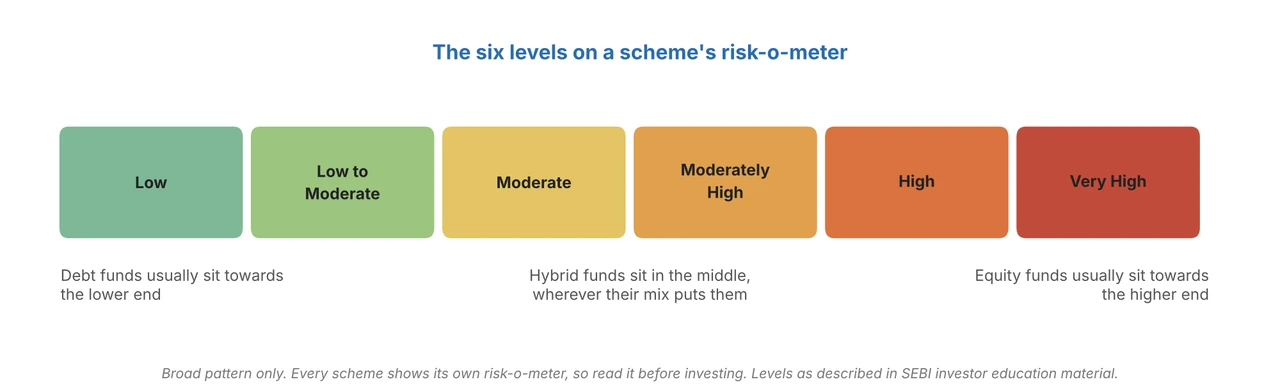
Two questions help before you choose. How long before you need this money? And how would you feel if its value fell sharply for a year or two?
A note from our co-founder
Most investors look backward. When markets fall sharply and past returns turn negative, panic sets in. As long as the original investment is intact they hold on, but once they see a loss they react and pull out. In the past, when markets fell for an extended period, longer-tenure SIPs turned negative and many people redeemed them. Awareness and education efforts by market participants have grown since, but the behaviour still shows up when markets fall.
What does a mutual fund cost?
A fund's running costs are shown as its expense ratio, a percentage of the fund's assets taken each year and reflected in the NAV. SEBI's material notes that expenses affect what you earn. Some funds also charge an exit load, a percentage of the NAV taken when you sell units within a stated period. SEBI no longer allows an entry load, and the offer document says whether an exit load applies.
Every fund comes in a direct plan and a regular plan. A direct plan is offered by the fund house itself, with no commission. A regular plan is bought through an intermediary such as a broker, advisor or distributor, who is paid a commission, so its expense ratio is higher and its returns are lower (SEBI investor education slides). The fund and its portfolio are the same, and only the cost differs. Small differences in cost add up over the years, which our index funds guide shows with an example.
A note from our co-founder
Most investors are blissfully unaware of expense ratios. Larger and more experienced investors tend to understand how much extra compounding a direct plan brings. People also confuse what a fund costs with how good or how risky it is, and that confusion leads to unsuitable investments.
How do I choose a mutual fund?
Start with the goal and work backwards. The checklist below keeps the choice simple.
- Match the goal and the time. Money you need in a year or two and money you will not touch for 15 years belong in different kinds of fund.
- Match the risk. Read the risk-o-meter and choose a level you can stay with when the market falls.
- Compare the cost. Among similar funds, look at the expense ratio and at whether you are in a direct or a regular plan.
- Read the scheme documents. The scheme information document covers the fund's objective, how it allocates assets, its strategy, how quickly you can get your money back and its fees. The statement of additional information covers statutory details and investor rights (SEBI investor education slides, slide 19).
How do I invest in mutual funds in India?
You can start in a day. KYC registration is done once, through KYC registration agencies registered with SEBI, and it covers the whole securities market. You then invest through a fund house's website or app, or through an AMFI-registered distributor, and you can use a SEBI registered investment advisor for advice.
Most people choose between a SIP and a lump sum. A SIP invests a fixed amount at set intervals, such as monthly, quarterly or half-yearly, for a commitment of 6 months or 1, 3 or 5 years. A lump sum is a single investment, and its value on the day depends on where the market stands that day. Because a SIP puts in the same rupees each time, it buys more units when the NAV is low and fewer when it is high.
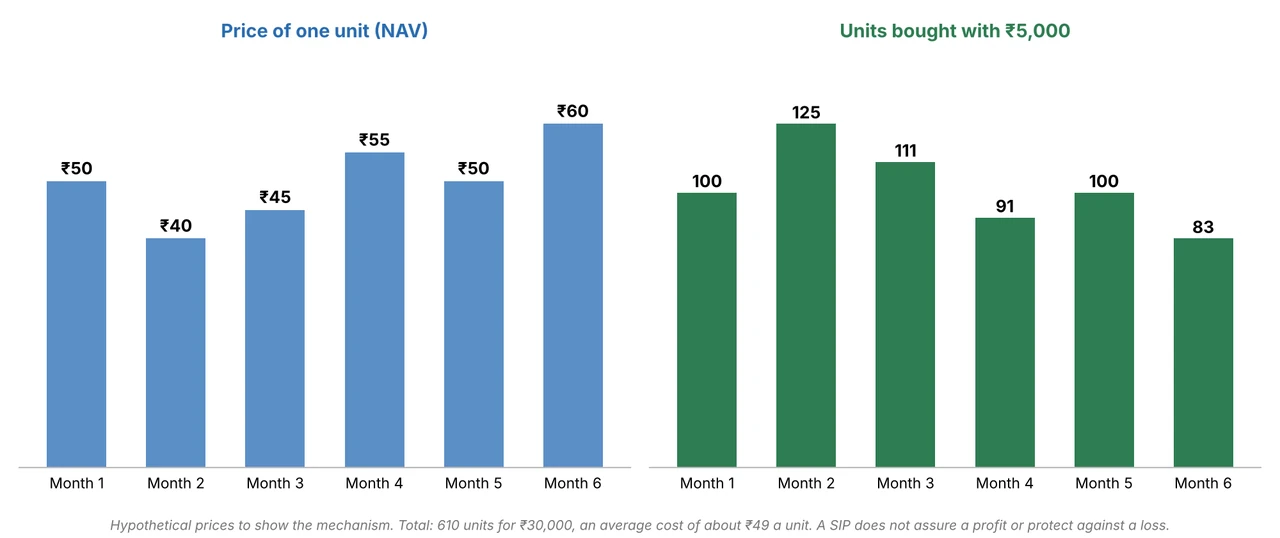
In the example, ₹5,000 buys 125 units when the NAV is ₹40 and 83 units when it is ₹60. A SIP does not assure a profit or shield you from a loss. Its main help is that you never have to decide when to invest.
What is the difference between growth and IDCW options?
Most schemes offer a growth option and an IDCW option. In the growth option, the gains stay in the fund and show up as a higher NAV. In the IDCW option (income distribution cum capital withdrawal, which used to be called the dividend option) the fund may pay out part of its money to you from time to time, and its NAV falls by the amount paid.
IDCW is not a promise of regular income. The fund pays only when it decides to, and a payout is a part of your own money coming back to you and not an extra return. IDCW is generally taxed as income in your hands, so check the position with your tax advisor. For long-term investing, many people prefer growth, because the money keeps compounding inside the fund.
What are SWP and STP?
A systematic withdrawal plan (SWP) takes a fixed amount out of your fund at set intervals, and a systematic transfer plan (STP) moves a fixed amount from one fund to another. They are the reverse and the sideways of a SIP. Both work by redeeming units, so each withdrawal or transfer can carry exit load and tax.
- SWP. You keep the rest of your money invested and receive a regular amount, which some people use for income in retirement. If you withdraw more than the fund earns, or markets fall, the balance shrinks, and it is not a guaranteed pension.
- STP. A common use is to put a lump sum in a lower-risk fund and move it into an equity fund in instalments, so that you do not invest it all at one price. It is the same idea as a SIP, funded from your own money in another fund.
How are mutual funds taxed?
Gains from mutual funds are taxable, and how much you pay depends on the type of fund, how long you hold it and the rules in force when you sell. Those rules change often, so this page does not quote rates or time limits. For your own situation, please consult your tax advisor.
What are my rights as a mutual fund investor?
SEBI's investor material says unitholders can exit a scheme at the prevailing NAV without an exit load if its fundamental attributes change, that they are entitled to a winding-up report if a scheme is closed, and that delays in paying redemption proceeds carry interest. The statement of additional information sets out the rights of investors in detail.
If you have a complaint, start with the fund house or its investor service centre, whose contact details are in the offer document. If it is not resolved, you can raise it on SEBI's SCORES complaints portal (opens in new tab).
A note from our co-founder
Keep your KYC up to date, and add a nominee, especially where a fund is held in a single name.
What mistakes do investors make with mutual funds?
Most of them come from how we react to markets and to numbers:
- Chasing last year's best fund. Herd behaviour pulls investors towards whatever has just done well, which often means buying near a high.
- Stopping a SIP after a fall. Loss aversion makes a loss feel more painful than an equal gain feels good, yet the months of low prices are when a SIP buys more units.
- Picking by NAV. A fund with a NAV of ₹15 is not cheaper than one with a NAV of ₹150. Only the change in value after you buy matters.
- Owning too many funds. Ten funds that hold the same companies are one investment with ten folios.
- Switching often. Overconfidence bias makes each switch feel like a good call, while costs and missed recoveries pile up.
- Using one fund for every goal. A house deposit in three years and retirement in twenty need different funds and different risk levels.
Investor psychology explains most of these behavioural mistakes, and a fixed monthly SIP removes many of the decisions where they show up.
A note from our co-founder
The mistakes with the biggest effect over the years are chasing past performance, stopping SIPs when markets are bad, spreading money across 10 to 15 funds, putting in more when markets are rising out of fear of missing out, and redeeming when markets are down out of panic.
Should I use a SEBI registered investment advisor for mutual funds?
You can choose funds yourself. An advisor helps most with the decisions around the fund: how much to hold in equity and debt, which goal each fund is for, when to reduce risk as a goal comes closer and how to stay invested when markets fall. If you choose one, check that they are registered, ask how they are paid, and read our guide to SEBI registered investment advisors (opens in new tab). time.money is a subscription-based financial advisor in India and a SEBI registered investment advisor (INA200015219), run by Karat Capital Advisors Pvt Ltd. We are a fee-only investment advisor and offer conflict-free wealth management for urban professionals, which means you pay a subscription and we earn nothing from the products you choose.
Sources
- SEBI, Investor Education Programme, Investment in Mutual Funds. Undated. Used for fund structure, NAV, loads, risk warnings, investor rights and complaints.
- SEBI Investor Website, Introduction to Mutual Funds Investing (January 2024). Used for fund types, direct and regular plans, KYC, SIPs, the risk-o-meter and scheme documents.
- SEBI, Categorization and Rationalization of Mutual Fund Schemes, 26 February 2026. Circular HO/24/13/15(2)2026-IMD-RAC4/I/5764/2026.
- Calculations by time.money. NAV: ₹200 lakh ÷ 10 lakh units. SIP: ₹5,000 ÷ each month's hypothetical NAV, 610.35 units in six months.